
From pencil lead
to one atom thick.
What is Graphene?
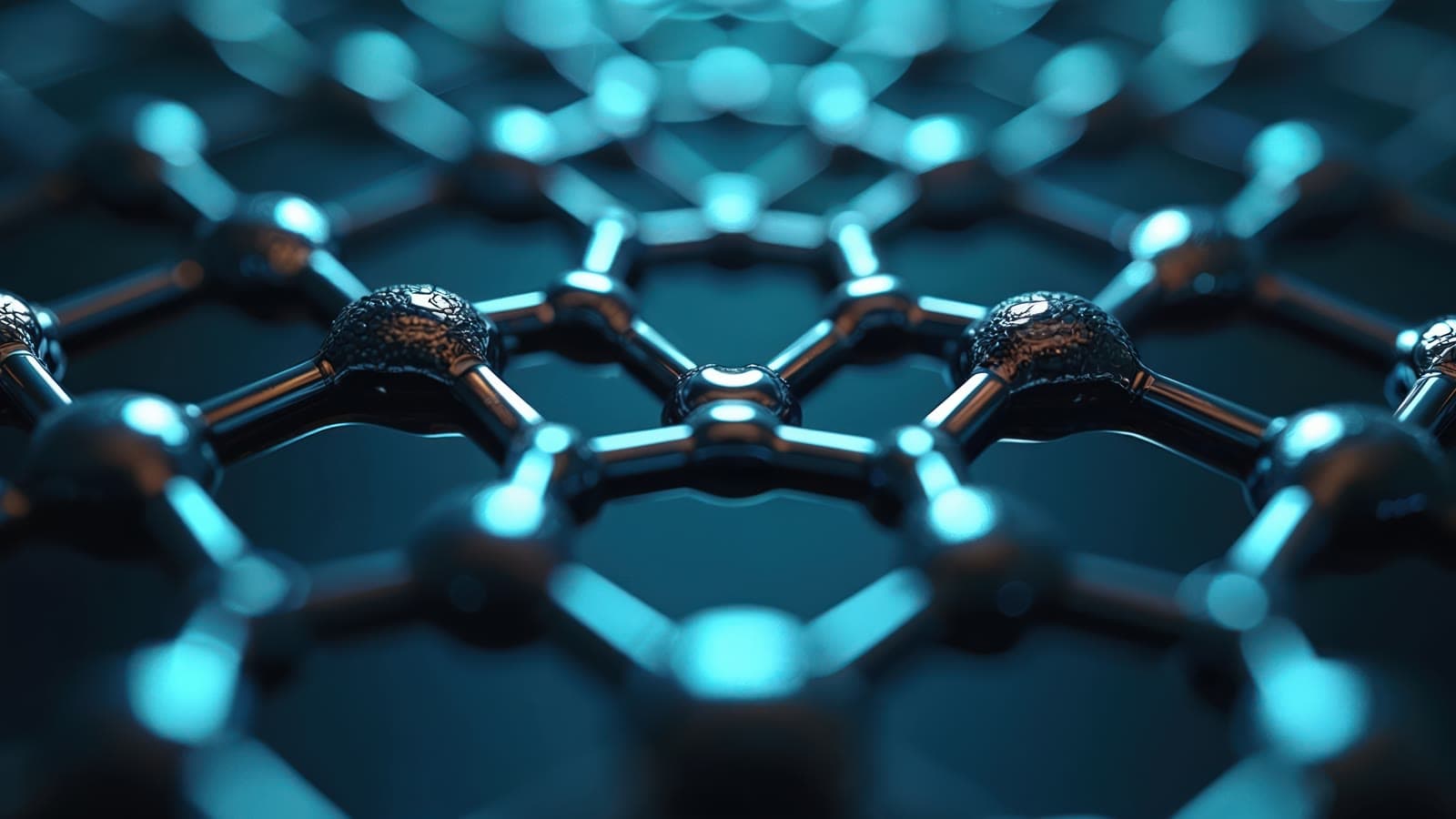
Graphene is a sheet of carbon atoms linked in a hexagonal mesh, just one atom thick. It is often called a wonder material, yet it is the same carbon found in pencil lead. This page explains, in plain language, what graphene is, what makes it special, how it is made, where it is used, and what it is made of.
01 / Graphene in three points
What is graphene? A single sheet of carbon.
Graphene sounds complicated, but it is made only of carbon, an element all around us. Three questions are enough to understand it: what it is made of, how thin it is, and how it differs from pencil lead.
Basics · 01
Made only of carbon
Graphene contains nothing but carbon (C), one of the most common elements on Earth. It is found in wood, paper and our own bodies. The same carbon atoms form different materials depending on how they are arranged. Diamond, pencil lead and graphene are all pure carbon.
Basics · 02
One atom thick
In graphene, carbon atoms link up in a hexagonal, honeycomb-like mesh to form a single sheet. The sheet is one carbon atom thick, about 0.3 nanometers, or roughly one three-millionth of a millimeter. It is, quite literally, as thin as a material can be.
Basics · 03
A close relative of pencil lead
Pencil lead is made of graphite, which is millions of graphene sheets stacked on top of each other. A pencil writes because thin layers peel off and stay on the paper. Graphene is what you get when you isolate just one of those layers.
02 / What makes it special
Thin yet strong. Conducts heat and electricity.
As a single sheet, carbon shows properties that are hidden when the layers are stacked. One material combines qualities that rarely go together, which is why graphene is called a wonder material.
- Strength
- About 100 times stronger than steel
- At the same thickness, graphene is far stronger than steel. It is also flexible and bends without breaking. Adding a very small amount to fibers or resins can raise the strength of the whole material.
- Electricity
- Electrons move faster than in copper
- Electrons travel across the sheet with very little scattering, so graphene conducts electricity extremely well. It is being applied in electronic components and battery electrodes.
- Heat
- Several times the thermal conductivity of copper
- Graphene moves heat exceptionally fast. This ability to spread heat quickly is used in heat-dissipation materials.
- Far-infrared
- Absorbs body heat and re-emits it
- Graphene emits far-infrared radiation efficiently. When it is blended into clothing, it absorbs the wearer's own body heat and emits far-infrared radiation, with no electricity or battery required.
- Thin and clear
- Transmits 97.7% of light
- A single graphene sheet is almost transparent. Because only a small amount is needed, it has little effect on the color and feel of fabrics or the clarity of cosmetics.
* Figures are approximate theoretical or reported values for single-layer graphene. Properties in finished products vary with the amount used and the form of the material.
03 / How it is made
How graphene is made: peel, dissolve, cut.
The raw material has always been close at hand. The hard part was separating it into a single layer, and that is the core of graphene's history. There are three main production methods, each with a different balance of quality and scalability.
Method · A
Peeling (mechanical exfoliation)
Layers are peeled away from graphite. The Nobel Prize-winning research in 2004 used ordinary adhesive tape to do this. The result is very pure, but the method cannot produce large quantities.
Method · B
Dissolving (chemical method, graphene oxide)
Strong acids and oxidizers are used to break graphite apart. This can produce large volumes, but chemical residues and defects in the crystal structure are common problems. Most graphene on the market is made this way.
Method · C
Cutting (purely physical process, GranovaQ)
Graphene is cut from graphite using physical force alone, with no chemicals, and then reduced further to nanometer size. No residues are left behind and the crystal structure stays intact. GranovaQ's GQD is made this way.
04 / Graphene and GQD
From sheets to quantum dots.
Graphene is a sheet. As a sheet, it measures anywhere from a few micrometers to a few millimeters across, which makes it hard to mix evenly into fibers or cosmetics, and it tends to clump together.
Cutting the sheet into particles a few tens of nanometers across produces graphene quantum dots (GQD). At this size, graphene keeps its properties while becoming easier to disperse and more transparent, and a new behavior called the "quantum size effect" appears.
GranovaQ® uses GQD as its material, in three grades with particle sizes of 10, 20 and 50 nm, chosen to suit each application.
05 / Where it is used
Already in everyday products.
Once a laboratory material, graphene is now finding its way into the things we wear, sleep on and put on our skin.
Apparel and recovery wear
Graphene is blended into the fabric, where it absorbs body heat and emits far-infrared radiation. It is used in recovery wear, including products notified in Japan as general medical devices.
Learn more →Bedding and innerwear
Used for functions marketed in Japan, such as antibacterial and odor-resistant, anti-mite and anti-mold. Most products blend the material into the fiber, which makes the functions resistant to washing.
Learn more →Cosmetics and hair care
Nano-sized graphene (GQD) is highly transparent and can be included in cosmetic formulations.
Learn more →Electronics and energy
Touch panels, battery electrodes and heat-dissipation materials. These fields make use of graphene's ability to conduct electricity and heat.
Learn more →* Functions such as antibacterial and odor-resistant, anti-mite and anti-mold describe the material itself, as marketed in Japan. They are not claims that any product protects people from bacteria, viruses or disease. Claims that may be made for products sold outside Japan depend on local regulations (for example, the U.S. EPA and the EU Biocidal Products Regulation). Please consult us for each market. See Functions.
06 / Composition and durability
Only carbon. No heavy metals.
Graphene is made only of carbon. Unlike metal-based additives such as silver or copper, it contains no metals, so there are no metals to leach out.
GranovaQ's GQD is made by a purely physical process without strong acids or oxidizers, so no chemical residues remain. It is blended into the fiber and bound there, rather than coated on the surface, so it is unlikely to come off through washing or wear, and its effect is long-lasting.
07 / FAQ
Common questions about graphene.
- Q. What is graphene, in one sentence?
- A. It is a sheet of carbon atoms arranged in hexagons, just one atom thick. The easiest way to picture it is a single layer peeled from pencil lead (graphite).
- Q. What is the difference between graphene and graphite?
- A. Graphite is millions of graphene sheets stacked together. Separate one sheet and you have graphene. Both are made of carbon, but as a single sheet the material becomes dramatically stronger and conducts electricity and heat far better.
- Q. What is the difference between graphene and graphene quantum dots (GQD)?
- A. GQD are graphene sheets cut into particles a few tens of nanometers across. At this size, a "quantum size effect" appears that sheet graphene does not have, and the particles are easier to disperse evenly in fibers and cosmetics. GranovaQ uses GQD.
- Q. What is graphene made of? Does it contain metals?
- A. Graphene is made only of carbon and contains no heavy metals. GranovaQ's material is made by a purely physical process with no chemicals, and it is blended into and bound within the fiber, so it is unlikely to come off through washing or wear.
- Q. Why is graphene called a "wonder material"?
- A. Because one material combines strength, electrical and thermal conductivity, thinness and transparency, properties that rarely go together. Research expanded worldwide after the 2010 Nobel Prize in Physics, and graphene is now starting to appear in everyday products such as clothing and cosmetics.
- Q. Why is graphene used in recovery wear?
- A. Graphene conducts heat well and emits far-infrared radiation efficiently. In a garment, it absorbs the wearer's body heat and emits far-infrared radiation, with no electricity or battery. In Japan, some recovery wear of this kind is notified as a general medical device; that status applies to Japan only.
- Q. Graphene is black. Does it change the color of fabric?
- A. Only a very small amount is used, so in most cases it has little effect on the color or feel of the fabric. Nano-sized GQD in particular is highly transparent and can be used in light-colored fabrics and cosmetics.
— More
To learn more about J.C. Technology, the company that develops and manufactures GranovaQ, visit its English website.
J.C. Technology Co., Ltd. (English)— Next
Shrink graphene to nano,and it goes quantum.
Now that you know what graphene is, the next step is GranovaQ's core material: graphene quantum dots (GQD). Learn why cutting graphene down to nanometer size changes how it behaves.