Ch.01
2004
Discovery
Discovery
Graphene, a carbon crystal one atom thick, is isolated for the first time. The work later wins the Nobel Prize in Physics.

Graphene quantum dot materials
Raising the bar for graphene materials.
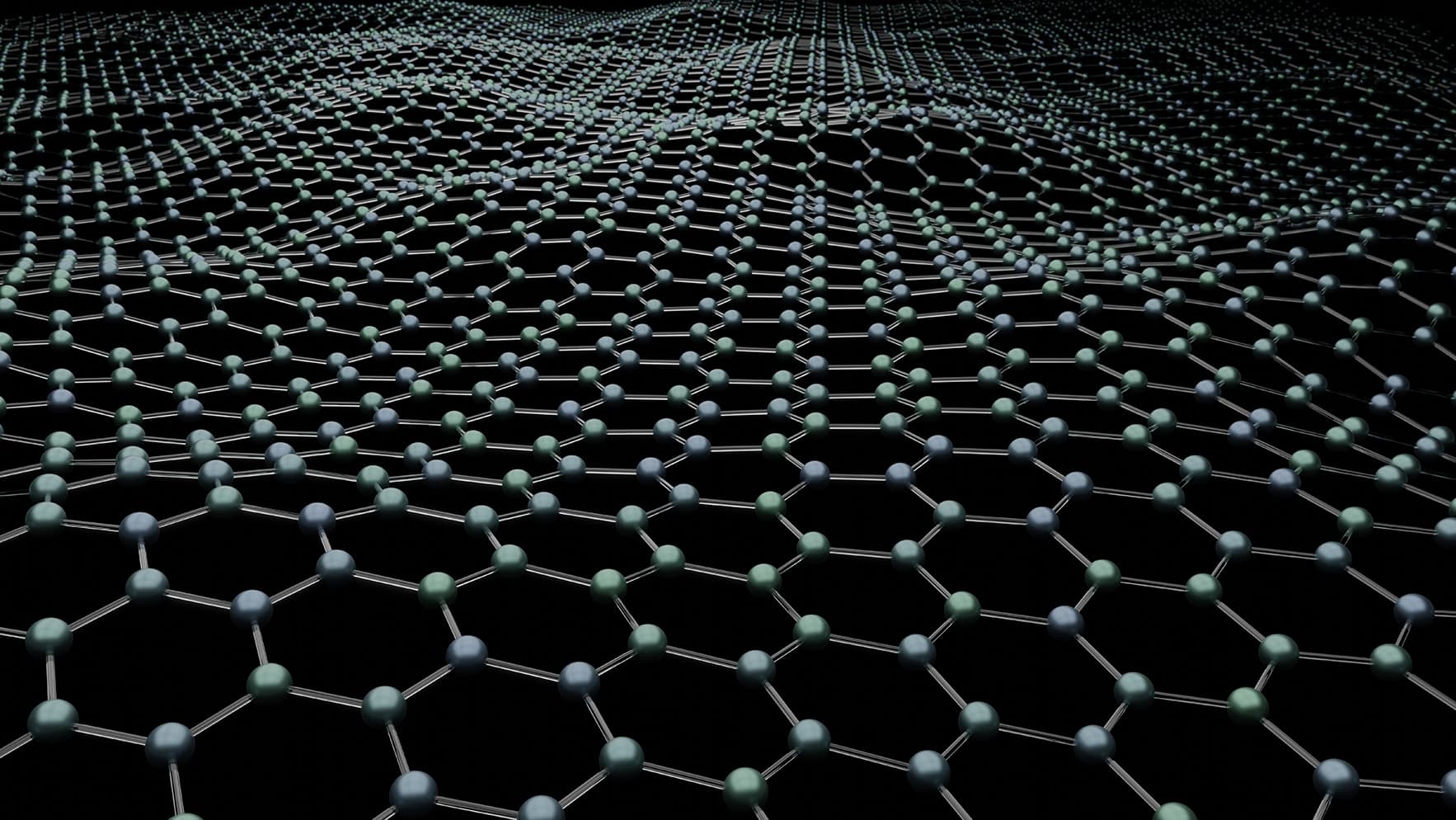
People have handled graphene for more than 400 years without knowing it. Graphite, the core of a pencil, is a stack of carbon layers; a single layer one atom thick is called graphene. It was first isolated in 2004, when Andre Geim and Konstantin Novoselov at the University of Manchester peeled graphite apart with adhesive tape. Their work led to the 2010 Nobel Prize in Physics, and graphene has since found its way into many materials.
GranovaQ is a graphene quantum dot material that is 4-free (no chemical additives, no heavy metals, no residual solvents, no lead). We bring what this nanomaterial can do to market through the brands that use it.
10·20·50 nm · Physical process · 4-Free · 21 patents
02 / Manifesto
— Choosing what you cannot see
Materials stay out of sight.
Yet they shape what a product does.
GranovaQ Inside appears on products made with materials that use GranovaQ. It gives the science inside a name and a place on the label.
03 / Story
In a little over twenty years, graphene sheets became nanoscale particles, and then a mark that products can carry. The story of GranovaQ Inside in four chapters.
Ch.01
2004
Discovery
Graphene, a carbon crystal one atom thick, is isolated for the first time. The work later wins the Nobel Prize in Physics.
Ch.02
2010s
Reduction
Sheets are broken down into nanometer-sized particles. As graphene quantum dots (GQD), they show quantum effects and new properties.
Ch.03
2026
Adoption
GQD made by a physical process goes into cosmetics, textiles and products for care settings, and reaches customers under the GranovaQ Inside mark.
Ch.04
Next
What's next
Building on the five functions marketed in Japan, the material is moving into new applications.
04 / Who this is for
05 / Requirements
Inside is not a mark anyone can use. Only materials that pass four requirements — loading, performance, durability and audit — may carry it on a product.
Requirements in detail →01 / Material
Contains GranovaQ GQD (10, 20 or 50 nm), produced by a physical process with no chemical additives, at or above the loading rate set for each industry.
02 / Performance
Offers the functions suited to the application, from the five marketed in Japan: antibacterial and odor-resistant, antiviral, anti-mite, anti-mold and far-infrared emission.
03 / Durability
GQD is bound into the material, so its functions hold up to repeated washing and last a long time.
04 / Audit
Agrees to the annual certification renewal and audit process.
06 / The material at a glance
0
Patents
Registered in China, Japan and elsewhere
0
Industries
Cosmetics, textiles, bedding and more
10·20·50nm
Particle size
Three grades for different uses
0
Functions
As marketed in Japan
For the five functions, see the Functions page. The functions describe the material itself, as marketed in Japan. They are not claims that any product protects people from bacteria, viruses or disease. Claims that may be made for products sold outside Japan depend on local regulations (for example, the U.S. EPA and the EU Biocidal Products Regulation). Please consult us for each market.
07 / Industries
08 / Structure
The Inside Program has three tiers to match the stage your brand is at. At its core is Inside, the visible logo that goes on the product.
Tier · 01
Powered by GranovaQ
The step before Inside certification. Credit GranovaQ as the source material on product pages and in investor materials.
Entry
Tier · 02
GranovaQ Inside
The core of the program. Brands that meet the four requirements — loading, performance, durability and audit — may carry the Inside logo on their products.
Mainline
Tier · 03
GranovaQ Certified
The highest tier above Inside, for high-loading product lines. Supports the Spec Stamp.
Apex
09 / FAQ
— In closing
Clearat a glance.
Quietly.
That’s the one.